

My daughter has a diary. It's bright pink and plastic and opens with a code. She got it for her seventh birthday. Like most of her notebooks, I'm not allowed to look inside. I can only look when she shows me. It's private, she says.
When I was a teenager, my mum read my diary. She read that I had been shopping with my cousin and we'd stolen some make-up. When she asked me about it, I lied. I told her I had made it up to show off. She believed me. It was then I found out I was a good liar. But something had been broken, and I didn't share with my diary in the same way for years.
Writing can be a private act. A moment to stop, reflect and evaluate — an event, a relationship or an idea about the self. It's a space to exist only for you. A way to get to know yourself better.
In Virginia Woolf's essay A Room of One's Own, she writes about the material conditions women need in order to have an independent intellectual and creative life: money, education, time, privacy, and, of course, a room of their own.
But what if family life, childcare, financial instability and limited space make this impossible? What if there is no room?
My girls built a den in their bedroom. I helped them hang cotton sheets from the lampshade that sprawled out to the corners of the room. They filled it with toys, books and blankets. I strung up some fairy lights. They ate their dinner in there. A new reality existed between the thin white walls.
They wouldn't let us in.
It was theirs and theirs alone. It stayed up for weeks.
It wasn't really a room. But it was a space. A territory they had created inside a room that already belonged to all of us.
And it isn't just dens and diaries. Girls' lives are full of moments like this: hiding places, notes stuffed into the pockets of bags, secret languages. Tiny moments that belong to them.
As a child, my mum taught me a version of back slang. A language formed by chopping up our existing one.
"You take the first letter and move it to the end. Then you add an A."
Once I mastered it, I'd talk in this new language for hours. Me, my mum, my aunts and my cousin. Our dads didn't understand, nor did our brothers. They hadn't been taught. In public, we could swear, or talk about others close by. We could hide behind its walls. It felt liberating and mischievous. It connected us, and it belonged to us. We didn't call it privacy. We didn't call it a female space. It was just what we did.
Perhaps this is what girls are doing when they make these small worlds. They are creating territories — places to connect, to imagine and to create worlds of their own. Places to witness themselves as they develop.
As adults, we still need these territories; we just make different ones.
The yoga class after work. The girls' night in. Walking the long way home. Sitting in the car for ten minutes before school pick-up.
We create these physical and psychological spaces, not necessarily because we want to disappear from our lives, but because sometimes we need to step outside the roles we occupy within them. To not be defined, for a moment, by what somebody else needs from us.
*
Then there is the digital space.
The WhatsApp group where we discuss the trivial and the serious, from missing school jumpers to whether our friend needs to leave her husband. The Mumsnet threads about loveless marriages and affairs. The voice note sent at 11pm because you need to tell someone what has happened before you can sleep.
These spaces can feel private. Their intimacy and semi-anonymity can enable a kind of freedom, becoming places where women say things they might not say anywhere else. But what is the effect of the private space turning outward? Is sharing everything a form of freedom or should some things be left unsaid?
I don't post on Instagram anymore, but I'm always on it.
My friend and her daughter on holiday in France. The woman I met in 2015 who has released a book. Someone I worked with five years ago is getting married. I am a witness. I don't like or share. I just watch.
I'm drawn to these public-private moments.
On TikTok, younger women have found entirely new ways to tell stories. Language develops: words such as “lore”, “side quests”, and “canon events” give new meaning to how they define the self. Everything is potential content — bedrooms become stages to get ready, bathrooms a place to cry, the car a space to confess.
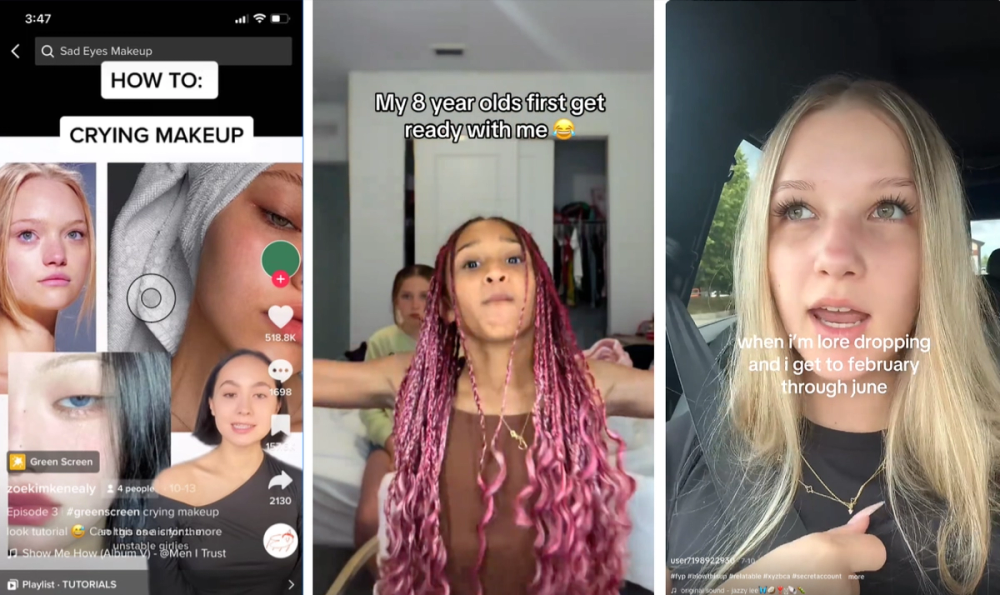
I'm uneasy about the expectation that we make our inner lives public. But what would I know? I'm 41. How would I begin to understand what it is like to grow up in a world where social media is simply part of the landscape, where your life can be photographed, filmed, captioned and shared almost as quickly as it is lived?
Growing up in this setting must create a different way of seeing yourself. Not just experiencing something, but seeing yourself experiencing it. Thinking about how it looks, how it might be received, what it says about you. The self becomes something you observe from the outside, shape and present.
Where does the private self go in all of this?
For generations, women have been silenced. Postnatal distress and private breakdowns were easily dismissed as hysteria. It was safer to conform and bury what couldn't be neatly expressed.
We now live in a time when, in some parts of society, women are more able than ever to speak openly. Of course, that openness is not universal; for many women and girls living with domestic violence, strict religious or social restrictions, or political repression, being open remains impossible, even dangerous.
Yet for those who can, things that were once private or shameful — relationships, sex, motherhood, mental health — can now be discussed publicly and collectively. Sharing can give us purpose, pleasure and connection: a sense of being part of something.
But at what cost?
Because nowadays, privacy is being performed. Vulnerability is content. We compare ourselves constantly, caught between the life we live and the life we present.
And yet, we still try to carve out smaller digital territories: the spam account with its unpolished feed, the private story, the group chat nobody outside understands.
And then there are the things that never leave our phones at all.
The unsent message. The reel we make and never upload. The Notes app entry. The hundreds of photographs sitting in our camera rolls that nobody else will ever see.
Perhaps these are the new diaries: hidden forms of expression, made without an audience. Thoughts formed without needing to become content.
*
We'll always have these private versions of ourselves. A space that's only ours.
It might be within four walls. It might be a page, or a private joke between friends. Some women go on a wellness retreat. Others have a weekend away with friends. We may have a study, a room with a door that closes. But most of us make do with smaller, stolen spaces: the dining room table cleared for work during the day, taking the dog out early while the mist is still clearing, the quiet chats with AI to help figure it all out.
Virginia Woolf argued that women needed a room of their own.
Maybe we've been making them all along.
Not always rooms. Small territories. Places to retreat, to think, to connect, to remember who we are when nobody is asking us to be anything else.
*
I tidied my daughter's room earlier while she was at school. Her diary was by her bed. I was tempted. But I didn't. Besides, I don't know the code.